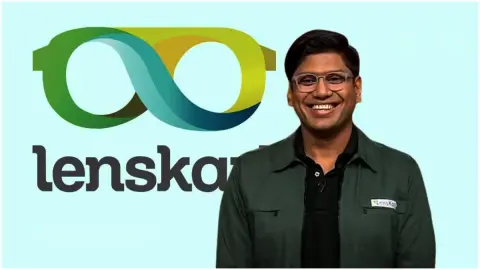
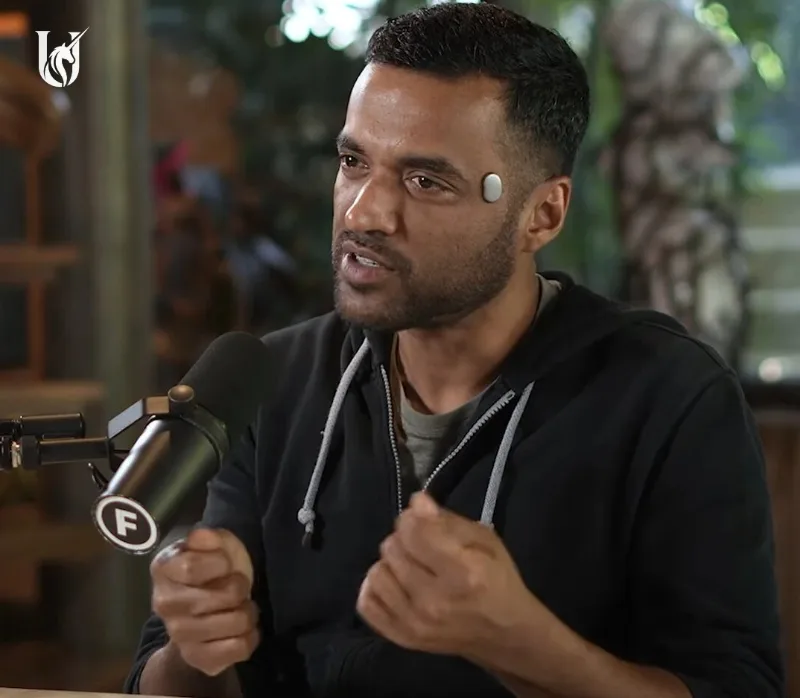
Deepinder Goyal, founder of Temple and former CEO of Eternal, has unveiled Temple, a screen-free AI wearable designed to capture its wearer's voice without using a conventional microphone. The first version, Temple 01, is expected to ship in early 2027 with AI and health-tracking features.
Goyal describes Temple as a “roomdeaf voice AI companion” and calls it “humanity's last personal device”. The wearable uses motion sensors to detect vibrations generated by the user's voice and convert them into text, with the aim of filtering out conversations and sounds from the surrounding environment.
The announcement marks Goyal's move into a new consumer technology category, combining voice-based AI interaction with personal health monitoring. Pre-orders for Temple Batch 01 opened on November 1, with the device reportedly priced at Rs 85,000. Deliveries are expected to follow in 2027.
How Temple's microphone-free AI technology works
Temple is designed to attach to the side of the head using medical-grade adhesive tapes called Grips. It does not have a microphone, camera or screen.
Users can activate the device with a double tap. A vibration indicates that it has started listening, while another signals that the interaction has been processed. Goyal says the wearable is designed for continuous use, including during sleep, workouts, showers and swimming, with recharging required approximately once a week.
The device is intended to act as a personal memory and reminder companion rather than a conventional digital assistant. Users will be able to dictate ideas, save observations, set reminders for birthdays and medication schedules, send messages and receive notifications through vibrations.
Goyal said the concept emerged from a health-wearable project he had been developing as a weekend experiment while leading Eternal. An engineering breakthrough during that work encouraged him to return to building full-time.
Health tracking and privacy are central to the product
Beyond AI interactions, Temple is being developed as a health and wellness wearable. Goyal said it already supports metrics such as heart rate, heart-rate variability (HRV), sleep and VO2 max.
The company is also working on features including chewing detection for calorie tracking, snoring-pattern monitoring, sleep-position tracking, jaw-clenching detection, REM sleep tracking and continuous core body temperature monitoring.
Goyal believes the device's position near the superficial temporal artery could help capture physiological signals that wrist- and finger-based wearables may not detect as effectively. He also referred to ongoing research into a metric called “Entropy”, although further details and validation findings have not yet been publicly established.
Privacy is another part of Temple's positioning. Goyal says conversations will be end-to-end encrypted and inaccessible to external model providers as well as Temple's own team. The company's published privacy policy also says it does not sell wellness data or use it for advertising.
Scientific validation remains a key test
Temple's ambitions extend beyond conventional fitness tracking, but its health-related claims will need to withstand independent scrutiny.
Doctors have questioned whether the device can reliably measure the brain-related physiological signals it claims to track. On November 6, Goyal defended the project, saying Temple had cost $30 million to develop, including $20 million from his personal funds. He also said preprints and independent studies would follow.
The distinction matters: a wearable's ability to record physiological signals does not, by itself, establish that its derived metrics are clinically reliable or useful. Temple is being positioned as a wellness and research product, not a medical diagnostic device.
For the wider wearable technology industry, Temple represents an attempt to move beyond wrist-based tracking and smartphone-dependent AI. Its commercial opportunity will depend not only on whether users find a screen-free companion useful, but also on whether the device can demonstrate the accuracy, reliability and privacy standards its positioning promises.
Goyal has described Temple 01 as the beginning of a longer development journey, with future versions expected to build on the company's research. The first major test will come when customers begin using the device at scale.